
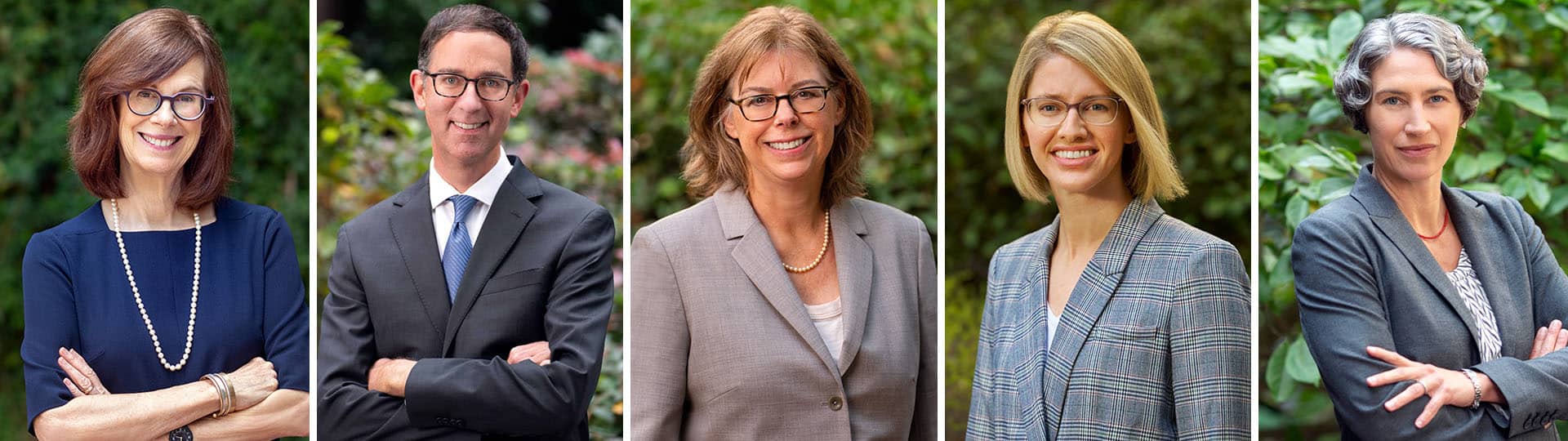
Five SMW Attorneys Earn 2026 CLAY Awards for Landmark CEQA Litigation Win
May 21, 2026A team of five Shute, Mihaly & Weinberger attorneys have won “California Lawyer Attorney of the Year” (CLAY) Awards from The Daily Journal for their work on a decade-long CEQA (California Environmental Quality Act) case in Kern County. The CLAY Awards went to Rachel B. Hooper, Kevin P. Bundy, Susannah T. French, Tori B. Gibbons, and Heather M. Minner, along with their co-counsel Daniel P. Selmi, Professor Emeritus at Loyola Law School.
The litigation challenged a Kern County ordinance, adopted at the request of the oil industry, to allow over-the-counter permitting for thousands of new oil and gas wells each year. The streamlined processing covers roughly 2.3 million acres of the San Joaquin Valley. The ordinance would cause substantial loss of farmland, as well as threats to public health and water supply for nearby communities. Shute, Mihaly & Weinberger (SMW) and Selmi filed suit on behalf of a local farming entity, V Lions Farming LLC (previously known as King and Gardiner Farms, LLC), concerned that expanded drilling would displace, fragment, and pollute the County’s high-quality farmland.
The SMW attorneys are sharing the awards with attorneys from Earthjustice, Center for Biological Diversity, Center on Race, Poverty & the Environment, Natural Resources Defense Council, and Sierra Club, who filed a companion case on behalf of a coalition of environmental justice and conservation groups.
“This case was unusual in its length and complexity, and in the sheer scope of what was at stake,” said CLAY Award winner Rachel Hooper. “The ordinance governs oil and gas drilling across 3,700 square miles, and we worked alongside attorneys with the Earthjustice coalition for more than a decade to make sure that it received the environmental review the law requires. We were thrilled to prevail in two published appellate decisions that resulted in the adoption of effective new mitigation, and to obtain stays of new drilling along the way.”
“The two opinions in this case have already been cited in dozens of California appellate decisions,” added CLAY winner Kevin Bundy. “Together they offer important guidance on some of the most contested issues in CEQA practice: when agencies can defer mitigation to a later date, how thoroughly they must consider feasible mitigation measures, how to set significance thresholds, and what the appropriate remedy looks like when a project has been approved on the basis of a flawed analysis. Those questions come up in projects of every kind across the state.”
In 2020, the Court of Appeal ruled that the environmental impact report (EIR) for the ordinance failed to comply with CEQA in addressing and mitigating impacts on farmland, water supplies, air quality, and noise, and that the County had improperly restricted public comment on a cumulative cancer risk study. King and Gardiner Farms, LLC v. County of Kern (2020) 45 Cal.App.5th 814. The Court ordered the County to set aside the ordinance and stop issuing permits.
Kern County responded by preparing a supplemental EIR and reapproving the ordinance in largely the same form in 2021. SMW filed new challenges, arguing the revised analysis failed to fix the problems the appellate court had identified and, in some cases, made them worse. When the County began issuing new drilling permits in violation of the court’s suspension order, the firm and Earthjustice went to court to stop the County from illegally issuing new drilling permits before the litigation was resolved.
In response to the trial court’s order, the County bolstered its farmland mitigation by requiring drilling applicants to compensate for farmland loss by removing old (“legacy”) equipment from potential farmland at a 1:1 ratio, including equipment located on off-site parcels. But, the County still refused to consider an agricultural conservation easement program, insisting – over SMW’s repeated protests – that the Court of Appeal had barred their use.
So SMW went to the Court of Appeal and won again. In March 2024, the Fifth Appellate District issued another published decision holding that conservation easements do constitute valid CEQA mitigation and that agricultural conservation easements should be considered as compensation for significant farmland loss. The 2024 decision directed the County to set aside both the ordinance and the supplemental EIR and barred new drilling permits until the County came into compliance. V Lions Farming, LLC v. County of Kern (2024) 100 Cal.App.5th 412.
In an unpublished portion of the decision, the Court of Appeal also rejected the County’s argument that it was not required to analyze or mitigate water supply impacts in disadvantaged communities and found the County’s study of cancer risks flawed for only assessing the risks from wells located 1,000 feet or more from sensitive locations when the ordinance permitted drilling much closer to homes and schools.
“One of the most significant outcomes of this litigation is the appellate court’s decision upholding conservation easements as a valid form of mitigation under CEQA,” said CLAY winner Susannah French. “That ruling establishes important precedent for protecting farmland, wetlands, wildlife habitat, and other sensitive resources throughout California.” Heather Minner, another CLAY winner, added, “Public agencies now have firm legal footing to use easements as a tool for long-term conservation, which is exactly the kind of durable environmental protection CEQA requires.”
The County subsequently conducted additional environmental review and reapproved the ordinance in 2025, this time committing to avoid or better mitigate the farmland, health, and water supply impacts of drilling in Central Valley communities. As noted by CLAY winner Tori Gibbons, “this litigation resulted in much improved and more extensive mitigation for the destruction of Kern farmland caused by new drilling. In the end, we achieved what our client wanted: to stand up to the oil industry to protect Kern agriculture and the rights of local farmers.”
About the CLAY Awards
The “California Lawyer Attorney of the Year” (CLAY) Awards are presented annually by the Daily Journal/California Lawyer to recognize the legal teams behind the state’s most consequential cases of the year. Honorees are selected across a broad range of practice areas, from complex litigation and antitrust to environmental law, civil rights, and tenants’ rights. The awards highlight verdicts, settlements, and rulings that reshape industries, set new legal precedent, and shape the practice of law for years to come. The 2026 awards honor 62 attorneys statewide.