logo
  • Home
  • About Us
    • Our Firm
    • Our People
    • Diversity, Equity & Inclusion
  • Practice Areas
    • Environmental Law
    • Municipal & Public Agency Law
    • Clean Energy Law
    • Local Ballot Measures
    • Tribal Law
    • Litigation & Appeals
  • News
    • Updates and Articles
    • Where We Work
  • Legal Hiring
  • Contact Us
Search For

415-552-7272

logo
  • Home
  • About Us
    • Our Firm
    • Our People
    • Diversity, Equity & Inclusion
  • Practice Areas
    • Environmental Law
    • Municipal & Public Agency Law
    • Clean Energy Law
    • Local Ballot Measures
    • Tribal Law
    • Litigation & Appeals
  • News
    • Updates and Articles
    • Where We Work
  • Legal Hiring
  • Contact Us
Search For

415-552-7272

  • Home
  • About Us
    • Our Firm
    • Our People
    • Diversity, Equity & Inclusion
  • Practice Areas
    • Environmental Law
    • Municipal & Public Agency Law
    • Clean Energy Law
    • Local Ballot Measures
    • Tribal Law
    • Litigation & Appeals
  • News
    • Updates and Articles
    • Where We Work
  • Legal Hiring
  • Contact Us

Eye on the Environment

February 2026

  1. Environmental Groups Reach Landmark Settlement to Limit Development at Palisades Tahoe Ski Resort
  2. Lawsuit seeks to enforce local zoning requirements on for-profit ICE detention facility in California City
  3. Groundbreaking Settlement Benefits Both the Environment and Housing
  4. Warehouse Settlements Achieve Meaningful Mitigation
  5. Guenoc Valley Settlement Preserves 4,000 Acres
  6. Conservation Groups Successfully Challenge County’s Inadequate Environmental Review
  7. Homewood Community Protects Public Access to Skiing on Lake Tahoe’s West Shore
  8. SMW Land Trust Clients Protect Thousands of Acres of Open Space and Agricultural Lands

Environmental Groups Reach Landmark Settlement to Limit Development at Palisades Tahoe Ski Resort

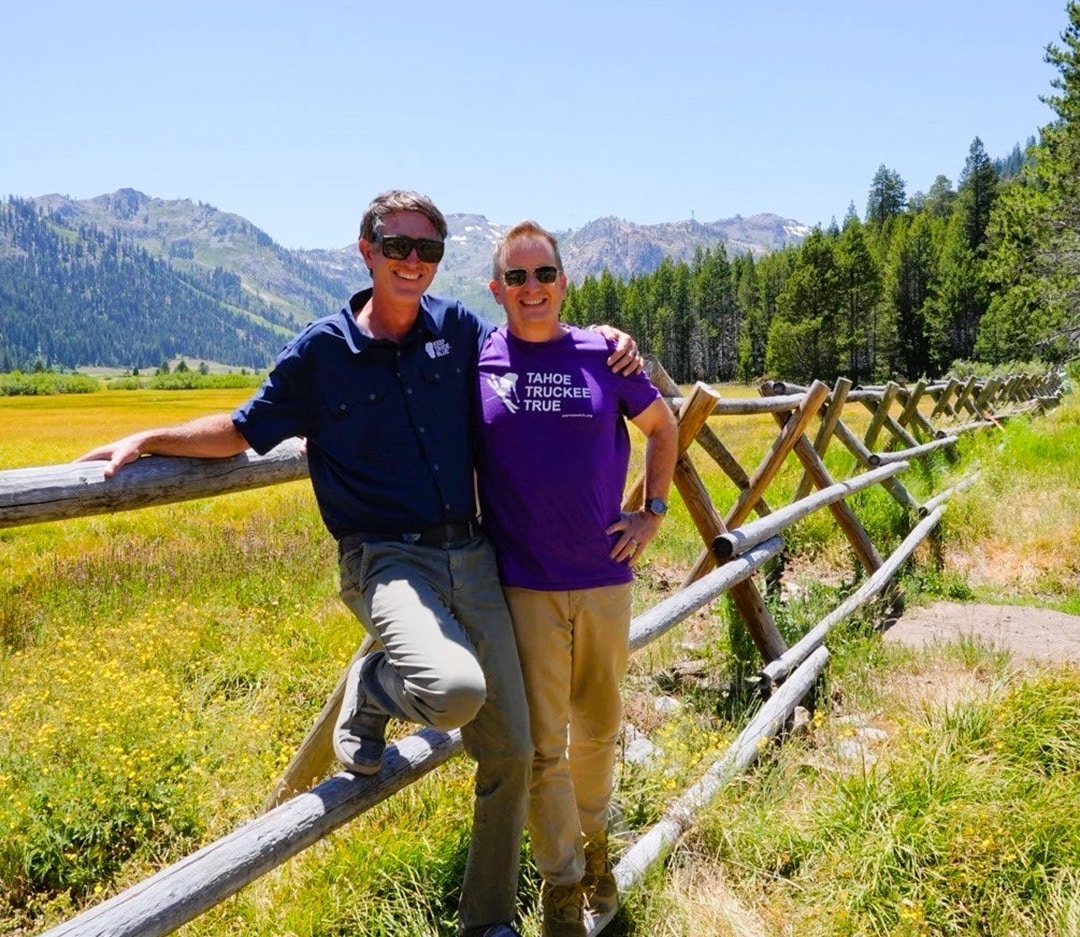
Jesse Patterson (Keep Tahoe Blue) and Tom Mooers (Sierra Watch) in Olympic Valley. Photo: Keep Tahoe Blue and Sierra Watch

In July 2025, long-standing SMW clients League to Save Lake Tahoe/Keep Tahoe Blue and Sierra Watch announced their historic agreement with Palisades Tahoe to reduce the size, scale, and impacts of the contentious expansion plan at the ski resort, which once held the 1960 Winter Olympics. The settlement was reached after years of conflict, including three separate lawsuits filed by the firm, and months of negotiations.

The agreement cuts the number of bedrooms allowed at the site by 40% and cuts commercial square footage by 20%, while maintaining important mitigation measures for the project’s environmental impacts, including impacts to water quality and clarity on nearby Lake Tahoe. It also ensures that Olympic Valley will not be home to a previously planned massive indoor waterpark. Sensitive parcels around the mouth of Shirley Canyon, which had been slated for development, will be preserved in perpetuity with a conservation easement. “This historic agreement is great news for our mountain communities and everyone who joined us in standing up to keep Tahoe Truckee True,” said Tom Mooers, Executive Director of Sierra Watch.

In 2021, the firm on behalf of Sierra Watch secured two published Court of Appeal victories against Placer County’s 2016 approvals of the massive development plan for Palisades. In one sweeping decision, the court ruled that the county violated CEQA by failing to analyze or mitigate the project’s impacts on nearby Lake Tahoe or its air basin, the project’s evacuation hazards in the event of wildfire, as well as the project’s noise and traffic impacts. This decision set an important precedent to ensure that projects such as Palisades that fall outside of the Lake Tahoe Basin boundary line must still analyze and mitigate the project’s significant impacts on the sensitive Basin. In the other decision, the court found that Placer County violated California’s open meeting law in its approval of the project. Pursuant to the court’s writ of mandate in the CEQA case, the County subsequently rescinded all the project approvals.

In 2024, after circulating some additional environmental review, Placer County approved a nearly identical development plan for Palisades Tahoe. Sierra Watch, joined by Keep Tahoe Blue, again filed suit on the grounds that the approvals failed to comply with CEQA or with the court’s prior writ of mandate. As part of the recent settlement, the groups agreed to drop their latest lawsuit challenging the current approvals for the project, pending Placer County’s approval of the reduced project blueprint. “When people work together, that’s the best way to Keep Tahoe Blue – now and for the future,” said Dr. Darcie Goodman Collins, Chief Executive Officer of Keep Tahoe Blue. “But when we need to take a stand to protect the Lake, we will, just like we have for almost 70 years.”

For more information, visit www.keeptahoeblue.org and www.sierrawatch.org.

–Amy Bricker

Back to Top

Lawsuit seeks to enforce local zoning requirements on for-profit ICE detention facility in California City

CoreCivic’s California City immigration detention facility.
Photo: Dignity Not Detention Coalition

In fall 2025, as U.S. Immigration and Customs Enforcement (ICE) escalated its raids on immigrant communities in Los Angeles and the Central Valley, SMW connected with the Dignity Not Detention Coalition to bring a challenge against multi-billion dollar private prison corporation CoreCivic’s unannounced, illegal reopening of a former prison in the middle of the Mojave Desert. The Coalition – includes nearly twenty different community organizations protecting civil liberties and immigrants’ rights – had learned that CoreCivic planned to civilly detain over 2,500 immigrants at its abandoned California City facility. SMW is co-counsel with the African Advocacy Network, which represents a co-plaintiff detained at the facility who is proceeding under pseudonym to protect against retaliation by the U.S. government and his country of origin.

The California City Correctional Facility was built in 1999 and for years, incarcerated state prisoners. In early 2024, the facility’s contract with the state expired and was not renewed, and the facility went dormant. However, in August 2025, CoreCivic suddenly and without warning to immigration justice advocates or California City residents reopened the facility as one of the state’s newest and largest “civil immigration processing centers.” Although CoreCivic had until then been taking steps to obtain, and the City appeared poised to issue, a business license for the facility, CoreCivic abandoned that process and determined instead to start filling its empty cells with detained people before securing any local government approvals.

The Coalition sought SMW’s experience in local government, land use, and environmental law to challenge CoreCivic’s unlawful reopening of the facility, and the City’s failure to require CoreCivic to obtain the proper approvals (including a conditional use permit) or to enforce its zoning code against CoreCivic once the facility illegally opened. CoreCivic’s premature repurposing of the facility also violates California’s Senate Bill (“SB”) 29, which requires at least 180 days’ notice and two public hearings before the construction or reuse of a private prison facility for civil immigration detention.

Conditions at the facility have been widely reported as inhumane and unconstitutional. Detained persons are routinely denied timely medical attention or medication for serious conditions; have limited access to hot food and clean water; are deprived of regular outside time or access to exercise; and are restricted in their ability to regularly communicate with legal counsel. Multiple suicide attempts have been reported, and people who have attempted to speak out against these conditions have been retaliated against, with solitary confinement and threats of physical violence. A class action lawsuit recently filed in the Northern District of California challenges these unlawful conditions on behalf of several individual detained persons and immigrant advocacy groups.

“This case helps ensure that private prison contractors are held accountable for violating local and state laws to open an immigration detention center that has already caused serious harm to community members,” says Jehan Laner, Senior Staff Attorney at the Immigrant Legal Resource Center (ILRC), one of the Coalition members. “Detention numbers are [already] at an all-time high,” notes Grisel Ruiz, Supervising Attorney with the ILRC, even as the federal government is attempting to further expand immigrant detention capacity to 100,000 beds across the country. “With California among the target locations for [detainment] expansion, our advocacy has never been more important,” she added. “Bringing this action shows those detained in this unlawful facility that they are not alone and that their community is standing with them,” says Callard Cowdery, SMW’s co-counsel with AAN.

The case is currently pending in the U.S. District Court for the Eastern District of California. SMW is proud to stand with the Coalition, African Advocacy Network and their client in this case, and California’s immigrant communities. As law firms across the country have come under intense pressure from Washington to silence their advocacy on behalf of underrepresented and persecuted communities, it is more important than ever that attorneys and social justice organizations increase their efforts to advance the rule of law.

For more information, contact Joseph Petta at petta@smwlaw.com.

– Dana Sweeney

Back to Top

Groundbreaking Settlement Benefits Both the Environment and Housing

The settlement will protect habitat for the endangered Quino checkerspot butterfly.
Photo: Robert Hamilton

After four years of intense negotiations, SMW and its clients Endangered Habitats League and California Native Plant Society, along with other environmental groups and the Attorney General’s Office, reached an innovative settlement agreement with the developer of the Otay Ranch Village 13 project that will significantly reduce the project’s development footprint while paving the way for a 50% increase in the project’s housing units.

Located east of Chula Vista, the Village 13 project planned to build 1,938 units of mostly high-end housing in undeveloped open space adjacent to Otay Lake, including habitat occupied by the endangered Quino checkerspot butterfly. On behalf of EHL and CNPS, SMW submitted extensive comments documenting the environmental impact report’s failure to adequately consider the project’s numerous environmental impacts, including impacts to the Quino checkerspot butterfly, fire hazard, wildfire evacuation, and greenhouse gas emissions. But the San Diego County Board of Supervisors approved the project anyway. EHL, CNPS, and allied environmental groups filed a CEQA lawsuit, which was later joined by the Attorney General.

After the suit was filed, the project developers—the Baldwin and Moeller companies—quickly agreed to enter into settlement discussions. To their credit, the developers remained engaged despite numerous challenging issues requiring creative solutions. By early 2025, the parties had finally reached an agreement. The settlement requires numerous new mitigation measures, such as improved wildfire monitoring and evacuation routes, 100% electric buildings with solar panels and EV chargers, and a $15 million GHG mitigation fund. But it also completely reimagines the project as a much denser development on a far smaller footprint. The development area was dramatically reduced by 40%, saving critically important Quino habitat from destruction. At the same time, the agreement allows the developers to seek approval for more than 800 additional units within the smaller footprint, of which at least 10% must be below market rate units. By building smaller homes on smaller lots, the revised project will not only provide more housing, but that housing will be more affordable.

The Village 13 settlement is another example of how the narrative of environment versus housing is a false choice. Designing development to reduce environmental impacts can actually make more housing accessible to more people – and benefit developers as well.

For more information, contact Dan Silver at EHL (dsilverla@me.com) or Amina Sharma at CNPS (asharma@cnps.org).

– Bill White

Back to Top

Warehouse Settlements Achieve Meaningful Mitigation

Warehouses are often proposed to be located on agricultural lands next to freeways and without regard to neighboring disadvantaged communities.
Photo: Public Domain

Warehouses have become notorious for their impacts on California’s communities. They consume substantial amounts of energy for lighting, climate control, and refrigeration; nighttime operations can subject neighbors to bright lights and unwanted noise; and the heavy-duty diesel trucks serving warehouse operations create significant health risks to neighboring communities, and everywhere they go. These impacts are especially acute in low-income communities of color, which are often on the front lines of warehouse development. As warehouses and their impacts have proliferated throughout the state, SMW clients, including the Sierra Club and the Center for Community Action and Environmental Justice (CCAEJ), have worked hard to protect their communities from the associated harms.

Two recent settlements under the California Environmental Quality Act (CEQA) have helped move the ball forward and have substantially reduced the burden that warehouses impose on neighbors and the environment.

First, in November 2024, the Sierra Club’s Delta-Sierra Group successfully negotiated additional mitigation measures for a new Costco warehouse in the City of Tracy. The Tracy Costco Depot Annex Project proposed to build and operate two large warehouse buildings to serve as an annex to a nearby Costco Depot and as a Direct Delivery Center. The two buildings and related infrastructure would develop almost the entire 104-acre agricultural site. During the environmental review process, the Sierra Club identified numerous concerns about the City’s failure to adequately analyze or mitigate the Project’s air quality, energy, and greenhouse gas impacts.

The Sierra Club leveraged these comments to negotiate a pre-litigation settlement that requires over 70 percent of heavy-duty trucks transporting goods from the facility to operations in other cities to be zero-emission by the end of 2027.[1] The agreement also requires the developer to use electric equipment on-site and to power the Project with 100 percent renewable energy. On-site solar power facilities must generate at least 3.8 megawatts of power for the Project. These requirements will substantially reduce the Project’s air pollutant and greenhouse gas emissions, allowing the residents of Tracy to “breathe a bit easier.”[2]

The Costco agreement builds upon a 2022 pre-litigation settlement that the Delta-Sierra Group negotiated with the City of Stockton and the developer of a 203-acre warehouse site to protect public health and reduce emissions and noise impacts through additional project commitments and accountability measures.

Similarly, in December 2024, CCAEJ and the Sierra Club’s Moreno Valley Group settled litigation over two light industrial warehouses in the City of Moreno Valley. As originally proposed, the Compass Danbe Centerpointe Project would have added almost 400,000 square feet of warehouse space directly across the street from homes and schools. The Project was expected to operate 24 hours per day, 7 days per week, and was forecast to generate more than 220 heavy-duty truck trips every day. CCAEJ and Sierra Club prevailed on a CEQA claim in the trial court, and the developer appealed.

The parties then negotiated a settlement that resolves the CEQA claims and “represents the strongest clean fleet requirements the Sierra Club has ever achieved in a warehouse settlement.”[3] Under that agreement, the warehouse facility’s entire fleet of heavy-duty trucks must be fully electric within three years from the date the first warehouse is certified to operate. Medium and light-duty vehicles must also be fully electric within seven years. If electric trucks are not available for purchase for less than 150 percent of the cost of an equivalent diesel truck based on a full cost-of-ownership model (including purchase incentives, rebates, and fuel costs for the first five years), the developer may temporarily delay compliance, but they must fully electrify the fleet within six months after compliant trucks become available.

The Compass Danbe settlement also requires the developer to route trucks to avoid schools and minimize the number of diesel trucks passing in front of neighboring homes. Further, like the Costco settlement, all warehouse operations must be fully electrified, and the facilities must include substantial rooftop solar and battery storage.

These two settlements serve as an important proof of concept for warehouse projects moving forward. Warehouse development should never displace people or bring harm to the communities that the development is intended to serve. But where warehouse projects are approved, meaningful mitigation is attainable.

For more information about these settlements or SMW’s warehouse practice, please contact Heather Minner at minner@smwlaw.com, Edward Schexnayder at schexnayder@smwlaw.com, or Andrew Miller at amiller@smwlaw.com.

– Andrew Miller

[1]Sierra Club, Costco Settlement Secures Groundbreaking Clean Truck Requirements in Tracy, December 2, 2024, available at https://www.sierraclub.org/press-releases/2024/12/sierra-club-costco-settlement-secures-groundbreaking-clean-truck.

[2]Id., quoting Sierra Club activist Eric Parfrey.

[3]Sierra Club Secures Unprecedented Clean Truck Requirements in Inland Empire Warehouse Settlement, December 17, 2024, available at https://www.sierraclub.org/press-releases/2024/12/sierra-club-secures-unprecedented-clean-truck-requirements-inland-empire.

Back to Top

Guenoc Valley Settlement Preserves 4,000 Acres

View of Guenoc Valley, Lake County.
Photo: Noelle Gillies (Creative Commons)

This past August, Shute, Mihaly & Weinberger helped the Center for Biological Diversity broker a settlement agreement that will preserve a vast undeveloped area in Lake County as conservation land.

The settlement stemmed from a challenge to the proposed Guenoc Valley Mixed-Use Development Project, a sprawling resort and residential project on 16,000 acres. In 2020, CBD and the California Native Plant Society filed a CEQA action, later joined by the California Attorney General, to overturn the County’s approval of the first phase of the project. After the petitioners won in the trial court, the Attorney General negotiated a settlement requiring the developer to adopt measures to reduce wildfire risk, improve evacuation routes, and install solar panels and electric vehicle chargers in all residential buildings. But CBD and CNPS fought on and expanded on their victory in the Court of Appeal.

After the County revised the project’s environmental impact report in response to the court’s direction, CBD asked SMW to help it negotiate a settlement ahead of the hearing to approve the revised project. After intensive negotiations, the parties were able to reach an agreement in just six weeks. The centerpiece of the settlement is a requirement that the developer dedicate a perpetual conservation easement over 4,000 acres of contiguous open space. The developer will provide $300,000 to the easement holder as an endowment for management of the easement lands, and an additional $2,000,000 for the preservation or enhancement of off-site conservation areas. The agreement also requires the developer to pay $2,500,000 to a third-party fund to be used for greenhouse gas emission reduction efforts, and to incorporate extensive habitat mitigation protocols, expanded aquatic habitat setbacks, and new groundwater protection measures into the project. The settlement will allow the first phase of the project to go forward, but reserves the rights of CBD and CNPS to challenge later phases.

For more information, please contact Peter Broderick at CBD at pbroderick@biologicaldiversity.org.

– Bill White

Back to Top

Conservation Groups Successfully Challenge County’s Inadequate Environmental Review

Native Grasslands at the Alpine Sports Complex Site.
Photo: Patrick Williams

The Cleveland National Forest Foundation (“CNFF”) and California Native Plant Society (“CNPS”), represented by the firm, recently prevailed in a CEQA challenge to a proposed sports complex in sensitive habitat on the outskirts of the community of Alpine in unincorporated San Diego County.

Roughly 30 miles from downtown San Diego and surrounded by the biologically sensitive and picturesque Cleveland National Forest, Alpine is home to a 230-acre nature preserve which supports a variety of endangered and special status species, including rare populations of Pallid Bat, Western Spadefoot Toad, and Quino Checkerspot Butterfly. The County owns a 96-acre parcel of undeveloped land directly adjacent to the nature preserve. Because the two parcels are contiguous, the County’s parcel supports many of the same species.

Despite its sensitive habitat, the County selected the site to build a sprawling 96-acre sports complex, known as Alpine Community Park. The development would include a massive turf field, an all-wheel area for bicycles, scooters, and skateboards, various hardtop sports courts, a baseball field, and other amenities, covering an area roughly equivalent to twenty contiguous football fields. Central to CNFF’s and CNPS’s concerns, the project would permanently destroy over 22 acres of rare native grassland habitat, replacing it with turf and concrete. Additionally, the thousands of expected visitors will introduce new potential wildfire ignition sources to the site, which is located in a state-designated extreme fire risk area.

In the face of heavy community opposition, the County Board of Supervisors approved the project and certified the EIR in December 2023. CNFF’s and CNPS’s lawsuit argued that the EIR failed to show that its mitigation measures would effectively protect demonstrated populations of Pallid Bat, Western Spadefoot Toad, and Quino Checkerspot Butterfly; that the County failed to adequately analyze the wildfire risks posed by the project; and that the County failed to consider the risks from increased traffic on the main road in and out of the proposed park, where multiple fatal accidents have occurred in recent years.

The court granted CNFF’s and CNPS’s request for writ of mandate and held that the EIR’s multiple shortcomings violated CEQA. In particular, the EIR had to actually analyze the effectiveness of its proposed mitigation measures for wildfire hazard, and had to produce evidence to support its proposed 200-foot construction noise buffer around potential Pallid Bat roosts, given that the County’s own bat expert had advised the County before it certified the EIR to adopt a minimum 500-foot buffer.

The court’s writ orders the County to rescind all project approvals and correct the EIR before moving forward. “We believe the outcome will be the protection of this very special place,” says Justin Daniel from firm client CNPS. According to CNFF’s Duncan McFetridge, “the court decision on the County’s flawed impact study for the park is a great win for the environment and for good planning.” Many in the community remain hopeful that the County will consider moving the park due to the significant concerns regarding its current location.

The ruling is particularly timely given the state legislature’s recent actions to weaken CEQA’s longstanding protections for the environment. CNFF’s and CNPS’s victory is a reminder that CEQA remains a powerful tool for demanding that government fully disclose the environmental consequences of its actions.

For more information, please contact Shasta M. Fields at sfields@smwlaw.com.

– Shasta Fields

Back to Top

Homewood Community Protects Public Access to Skiing on Lake Tahoe’s West Shore

West Shore, Lake Tahoe.
Photo: Rick Cooper (Creative Commons BY 2.0)

What does it mean for the public to have access to a treasured recreational resource? That is the question that SMW client Keep Homewood Public pressed the Tahoe Regional Planning Agency (“TRPA”) to answer last January. As the primary land use planning authority in the Lake Tahoe Basin, TRPA is responsible for managing the development and operation of the region’s ski areas. Its mission is to ensure that recreational development is balanced with housing, environmental concerns, and other resident- and visitor-serving land uses. TRPA achieves this goal in part through ski area master plans– a tool that, like a land use plan under state planning and zoning law, sets design standards and operational constraints for ski area development.

Beginning in 2023, the owners of Homewood Mountain Resort on Lake Tahoe’s West Shore proposed to start development under their 2011 Ski Area Master Plan – but with one major change. The Master Plan required the Resort to operate as a heritage resource that could be enjoyed equally by local West Shore residents and visitors. The Resort owners, however, proposed to shift to a private country club-style of operation, with members-only passes and limited access for the broader community. The community organized Keep Homewood Public to push back.

Keep Homewood Public had an early victory in 2024 when it convinced TRPA that any operational changes would require a Master Plan amendment. The Resort owners then tried to backpedal and told TRPA they would abandon their plans to restrict access to the ski hill. But behind closed doors, talk of privatization continued. Keep Homewood Public did not stop pushing.

Their fight came to a head on January 22, 2025, when – at Keep Homewood Public’s behest – TRPA adopted a first-of-its-kind Community Access Plan for Homewood Mountain Resort. The Plan includes specific public access requirements to ensure that the ski hill remains a valuable resource for the Homewood community, the Lake Tahoe region, and its visitors. Under the Plan, any failure to meet these requirements will be treated as an enforceable “violation of [the] Ski Area Master Plan.” And, importantly, the Resort will submit annual reports to TRPA demonstrating compliance with the Plan. For the first time since Homewood committed to being a public resource in 2011, the community has measurable and enforceable standards to ensure that that goal is actually realized.

Keep Homewood Public’s victory highlights what is possible when SMW clients bring to bear their passion and tenacity. Keep Homewood Public’s steering committee of six converted SMW’s legal advice into an actionable plan and grassroots messaging. Dozens of committed volunteers then used those lessons to mobilize thousands of passionate Homewood advocates to successfully hold TRPA accountable for defending public access to the ski hill.

Forging a new path against entrenched and well-funded interests can be daunting. But Keep Homewood Public’s success proves that with strong grassroots enthusiasm and experienced legal and policy advice, you can achieve unprecedented results.

For more information about Keep Homewood Public’s efforts to preserve public access to skiing on Lake Tahoe’s West Shore, contact Seph Petta at petta@smwlaw.com or Andrew Miller at amiller@smwlaw.com.

– Andrew Miller

Back to Top

SMW Land Trust Clients Protect Thousands of Acres of Open Space and Agricultural Lands

Lauren Miller, Sara Clark, and Bridget Fithian at the Waltz Turner Ranch.
Photo: Sierra Foothills Conservancy

Shute, Mihaly & Weinberger has represented land trusts across California for over 20 years. The firm helps place and keep land under conservation protection by advising clients in transactions, enforcement, and litigation related to land trusts, as well as a wide variety of related topics from water rights to accreditation by the Land Trust Alliance.

Some of the most gratifying moments in this work come when SMW helps clients protect important habitat, agricultural, and other open space properties. In the past few years, SMW clients closed several major transactions, many of which reflect years of work by the land trusts and other partners. These recent successes include the following:

  • The Peninsula Open Space Trust, advised by SMW, completed a multi-phased project permanently protecting the Estrada Ranch in the Southern Santa Cruz Mountains in partnership with the Estrada family and the Land Trust of Santa Cruz County. POST purchased 839 acres of the ranch, then worked with LTSCC and the family to place a working forest conservation easement over all 1,204 acres of the ranch. This allowed POST to transfer the acres it had purchased – now under conservation easement – back to the Estradas. The family, which has sustainably ranched and harvested timber on the ranch for more than 150 years, will continue to own and manage the land.
  • POST also closed on the 1,340-acre Pescadero Ranch in southeastern Santa Cruz County. This property is part of a critical landscape linkage between the Santa Cruz Mountains and the Gabilan Range. POST’s purchase will ensure permanent protection for multiple at-risk species along with the property’s streams, ponds, and wetlands.
  • In the past two years, POST has transferred more than 5,700 acres to Midpeninsula Regional Open Space District, known as Midpen, at Cloverdale and Johnston Ranches. The Cloverdale property will become Midpen’s 27th open space preserve, while Johnston Ranch will become part of the existing Miramontes Ridge Open Space Preserve. In these transactions, POST transferred the upland portions of the properties to Midpen while retaining the row-crop farmland and coastal bluffs to preserve agricultural land along the San Mateo Coast.
  • SMW helped the Sonoma Land Trust and its partners purchase the 654-acre McCormick Ranch in December 2023. The land spans portions of Sonoma and Napa counties and includes a critical segment of a wildlife corridor for black bear and mountain lion, as well as the headwaters of three major creeks. Once open to the public, McCormick Ranch will expand Hood Mountain Regional Park and increase potential connections to adjacent Sugarloaf Ridge State Park.
  • SMW also worked with the Sonoma Land Trust in 2023 to purchase the 1,149-acre Camp 4 property and in 2024 to acquire the 1,460-acre Kiser Ranch. Both properties are in the Sonoma Baylands and will be restored to tidal wetlands, which will provide resilience against sea level rise. The properties also provide vital habitat for special status plants, fish, and wildlife, including the endangered Ridgway’s rail and salt marsh harvest mouse.
  • In 2024, SMW helped the Sierra Foothill Conservancy use funds from the California Department of Conservation’s Sustainable Agricultural Lands Conservation Program to acquire the vast 10,361-acre Waltz-Turner Ranch Conservation Easement in Merced and Mariposa Counties. This is the conservancy’s largest acquisition to date. The easement permanently protects working rangeland, native plants, cultural and historical resources, and critical wildlife habitat. It also protects the property’s seasonal wetlands, 140 miles of streams, and dozens of ponds and springs, which are home to various special status species, including the California tiger salamander and vernal pool fairy shrimp.
  • In the past two years, the Sierra Foothill Conservancy also closed on the 571-acre Indian Gulch Ranch Conservation Easement and the 633-acre Triangle Ranch Conservation Easement, both in Mariposa County. The easements permanently protect working rangeland, annual grassland, oak woodland, riparian and wildlife corridors, and critical habitat.
  • SMW helped Yolo Land Trust use funds granted through the California Climate Investments Sustainable Agricultural Lands Conservation Program to protect almost 120 acres of prime farmland and highly productive soils. This acquisition will keep the property in agricultural production even in the face of increasing development pressure along the I-80 corridor just outside of Davis.
  • SMW also assisted YLT in drafting and closing a conservation easement on over 100 acres of prime farmland just outside of the City of Woodland in Yolo County. This conservation easement serves as county-required farmland mitigation for a county-approved aggregate mining project and allows YLT to work collaboratively with the landowner, developer, and county.

Join us in celebrating these victories, each of which preserves an important piece of California’s open space and agricultural lands forever.

For more information, contact Sarah Sigman at sigman@smwlaw.com, Sara Clark at clark@smwlaw.com, or Caitlin Brown at brown@smwlaw.com.

– Chloe Lew

Back To Top
default logo

Counsel and representation in government, land use, renewable energy, and environmental legal matters for public agencies, non-profits, tribes, and community groups.

Quick Links

  • Our Firm
  • Our People
  • Diversity, Equity & Inclusion
  • News
  • Legal Hiring
  • Contact Us
  • Celebrating 40 Years
  • Disclaimer
  • Terms of Use
  • Opt-out preferences
  • Cookie Policy
  • Privacy Statement

Practice Areas

  • Environmental Law
  • Municipal and Public Agency Law
  • Clean Energy Law
  • Local Ballot Measures
  • Tribal Law
  • Litigation and Appeals

Office

Shute, Mihaly & Weinberger LLP

550 California Street

Suite 1200

San Francisco, CA 94104

By Phone: (415) 552-7272

By Email: info@smwlaw.com

  • Facebook
  • LinkedIn
  • Instagram
DEI Seal

© 2026 Shute, Mihaly & Weinberger LLP, All Rights Reserved

Manage Cookie Consent
We use cookies to optimize our website and our service.
Functional Always active
The technical storage or access is strictly necessary for the legitimate purpose of enabling the use of a specific service explicitly requested by the subscriber or user, or for the sole purpose of carrying out the transmission of a communication over an electronic communications network.
Preferences
The technical storage or access is necessary for the legitimate purpose of storing preferences that are not requested by the subscriber or user.
Statistics
The technical storage or access that is used exclusively for statistical purposes. The technical storage or access that is used exclusively for anonymous statistical purposes. Without a subpoena, voluntary compliance on the part of your Internet Service Provider, or additional records from a third party, information stored or retrieved for this purpose alone cannot usually be used to identify you.
Marketing
The technical storage or access is required to create user profiles to send advertising, or to track the user on a website or across several websites for similar marketing purposes.
  • Manage options
  • Manage services
  • Manage {vendor_count} vendors
  • Read more about these purposes
Preferences
  • {title}
  • {title}
  • {title}